When you’re running a smaller team, every minute counts.
You likely don’t have a massive “growth department” or an army of SDRs. There’s just you, maybe a sales rep or a marketing generalist, and a to-do list that only seems to get longer.
So when you check your analytics and see a spike in website traffic, it feels like a win.
You think, “Great! People are looking at us! Now what?”
The natural instinct? Grab that list and start reaching out.
But here’s the truth: website traffic is raw data. It is not a ready-to-go lead list. On average, only around 1–2% of B2B visitors ever convert into a lead in the first place, and the rest stay anonymous “window shoppers.”
The Triage Trap
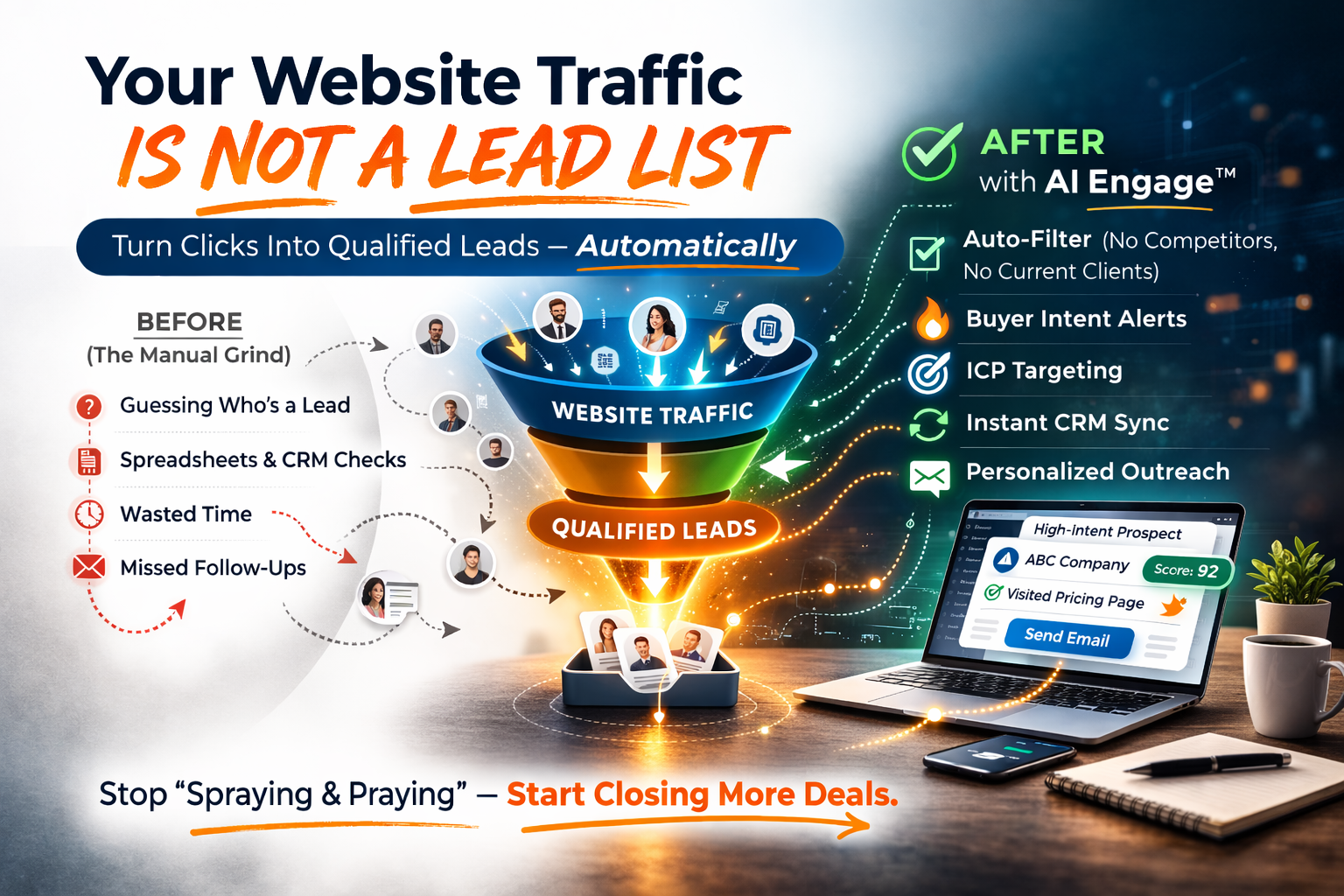
If you start “spraying and praying” to everyone who lands on your homepage, you’re setting yourself up for awkward conversations.
And for an SMB, the manual detective work required to turn traffic into a real opportunity is painful.
Before you even hit send, you have to ask:
- Are they already a client? Nothing damages trust faster than pitching a new service to someone who’s still waiting on a support ticket. In many B2B funnels, 30–40% of “new” leads turn out to be existing contacts or customers once you de-duplicate the data.
- Are they a competitor? You probably don’t want to send your best sales deck to the company across town. In a typical B2B environment, it’s common for a meaningful slice of traffic to come from competitors, partners, and job-seekers rather than true buyers.
- Do they actually fit your Ideal Customer Profile (ICP)? A visitor isn’t automatically a qualified prospect. Benchmarks show that while about 1–2% of visitors might become leads, only a fraction of those will ever match your ICP tightly enough to become real opportunities.
- What were they looking at? Someone who spent 10 minutes on your pricing page is very different from someone who skimmed a blog post and bounced. Buyers now do a large portion of their research anonymously, and they often shortlist vendors before ever filling out a form, which means behavior signals (pages viewed, depth of visit, repeat visits) matter far more than a single click.
This manual triage is what we call the modern sales execution gap.
Most organizations have plenty of insights and data.
What they struggle with is turning those insights into actual pipeline and revenue. When only about 1–1.5% of visitors turn into leads and roughly 1–5% of leads ever become customers, every mis-prioritized follow-up hurts.
And in an SMB, that gap feels even wider, because you don’t have extra hands to close it.
The SMB Trap: The Manual Dig
Here’s how it usually plays out:
- You export visitor data.
- You cross-check your CRM.
- You search LinkedIn.
- You try to guess intent.
- You draft an email.
- You repeat.
Meanwhile, B2B buyers keep researching in the background. Many now stay anonymous for most of their journey and only contact vendors when they’re already 60% or more through their decision process and have quietly ranked their shortlist.
By the time you reach out, the prospect has either forgotten about you or moved on to a competitor who followed up faster and with more relevant context.
It’s messy. It’s slow. And it doesn’t scale.
Enter AI Engage™: Your Personal Autopilot
This is where KnowledgeNet.ai changes the game.
Their AI Engage™ platform is built specifically to bridge that sales execution gap. Think of it as an autopilot for outbound, one that turns raw website activity into qualified, prioritized conversations.
Instead of spending hours manually cross-checking names and researching accounts, the system does the heavy lifting for you.
Here’s how AI Engage transforms noise into revenue:
- Intelligent Filtering: The system automatically filters out existing clients and competitor domains, so you only see net-new opportunities worth your time. In funnels where only ~1–2% of visitors ever become leads, filtering out the “noise” is the difference between chasing ghosts and focusing on buyers.
- Buyer Intent Detection: It doesn’t just track clicks, it detects when prospects are actively researching solutions like yours and prioritizes accounts showing genuine buying intent. Signals like repeat visits to pricing or service pages, asset downloads, and deep time-on-page correlate strongly with higher downstream conversion.
- Automatic ICP Enrichment: AI Engage continuously discovers and enriches prospects with firmographic and intent data, syncing everything directly into your CRM, no rep intervention required. When your “website visitor → MQL” step is only converting around 1–3%, better enrichment can be the lever that moves you closer to top-performer territory.
- Hyper-Personalized Outreach: When it’s time to reach out, the AI drafts messages using persona insights and lead history so every touchpoint feels thoughtful, relevant, and timely, not generic. Across channels like email and social, more tailored outreach consistently produces much higher engagement and lead-to-MQL conversion, compared to generic blasts.
In other words, you stop reacting to traffic and start acting on signals.

From “More Traffic” to “Better Conversations”
For a growing SMB, the goal shouldn’t be more visitors.
It should be better signals.
When you automate the “who, what, and why” behind your website activity:
- Sales conversations feel warmer, because you’re leaning into accounts that have already shown real interest.
- Outreach happens faster, closing the gap between intent and first touch while buyers are still actively researching.
- Follow-ups are context-aware, using page history and engagement patterns rather than generic pitches.
- Your team reclaims hours every week that used to vanish into spreadsheets and manual research.
Instead of drowning in spreadsheets and browser tabs, you focus on strategic selling and closing deals. That’s how small teams scale without burning out.
The Bottom Line
Stop treating your website traffic like a giant bucket of leads.
Start treating it like a funnel that needs a filter.
When you close the modern sales execution gap, traffic becomes opportunity, and opportunity becomes pipeline. Benchmarks show that top-performing companies can convert visitors to leads at rates several times higher than the average, and improving just a few key steps in your funnel can translate into meaningful revenue gains.
If you’re ready to stop digging through spreadsheets and start driving meaningful conversations, let’s talk.
We’d love to show you how AI Engage can turn your website intent into a steady, qualified pipeline.